Why Quality Investing Matters More Than Ever
Equity markets reward patience, discipline, and the ability
to stay invested through ups and downs. While short term
trends often grab attention, long-term wealth creation has
historically been driven by investing in
high quality businesses-companies that can sustain
performance across market cycles.
Quality investing focuses not on temporary excitement,but on
enduring business strength. It seeks to identify
companies that are built to last and can continue to deliver
value even when economic conditions change.
Understanding Quality Investing
A useful way to think about quality investing is to compare
it to building a strong sports team. A quality team is not
made of players who perform well in just one match; it
consists of players who deliver
long innings, maintain a high average, and adapt to
different pitches.
Similarly, quality businesses typically demonstrate:
-
Strong and consistent profitability
-
Low debt and resilient balance sheets
-
Stable earnings over time
-
Capable and ethical management
-
Sustainable competitive advantages
Such businesses may not always be the cheapest in the
market, but they aim to generate value steadily over the
long term.
The Importance of an Economic Moat
One of the defining traits of quality companies is the
presence of an economic moat-a structural advantage that
protects the business from competition.
This moat can take many forms, such as:
-
Well‑established brands
-
Technological leadership
-
Economies of scale
-
Network effects
-
High switching costs for customers
These advantages help companies maintain pricing power,
protect margins, and continue growing even in challenging
market environments.
Quality and Peace of Mind for Investors
Market volatility is inevitable. Global financial crises,
economic slowdowns, and geopolitical events often cause
sharp market corrections. While no equity investment is
immune to short‑term fluctuations, quality‑focused
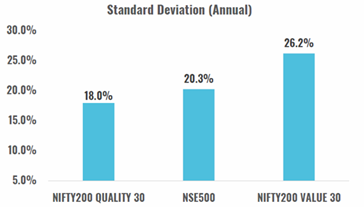
portfolios have historically demonstrated
lower volatility and smaller drawdowns compared to
broader market indices.
Source
www.niftyindices.com. The above graph is used to explain the concept and for
illustration purposes only and should not be used for the
development or implementation of an investment strategy.
Over long periods, quality‑based indices have also delivered
stronger long‑term returns, reflecting the power of
consistent earnings and disciplined capital allocation. For
investors, this can translate into a smoother investing
journey and greater peace of mind.
Quality Investing Is a Long‑Term Approach
Quality investing requires a long‑term mindset. The benefits
of superior business models, good governance, and strong
balance sheets do not appear overnight—they compound
gradually over time.
Periods of underperformance are not uncommon. History shows
that extended phases when quality underperforms
value‑oriented approaches are often followed by
strong rebounds. Investors who remain patient during
such phases may be better positioned to benefit when quality
regains leadership.
Historically, extended phases of 3-year rolling
underperformance of Quality
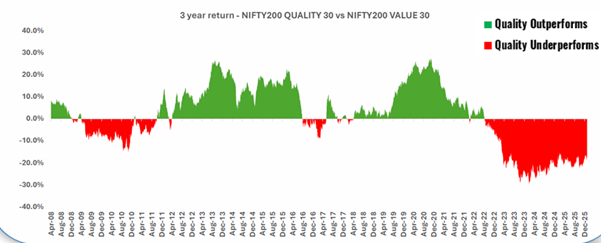 Source : MFI explorer, Data for the period April 2005 –
Dec 2025. The above is for illustration purpose only, It
should not be construed to be indicative of scheme
performance in any manner. Past performance may or may not
be sustained in future.
Source : MFI explorer, Data for the period April 2005 –
Dec 2025. The above is for illustration purpose only, It
should not be construed to be indicative of scheme
performance in any manner. Past performance may or may not
be sustained in future.
How Quality Stocks Are Identified
Quality cannot be captured through a single metric. A
disciplined quality approach combines
quantitative filters with
qualitative assessment.
Key factors usually include:
-
High return on equity and capital
-
Low leverage and balance sheet strength
-
Earnings stability and cash flow generation
-
Large market opportunity
-
Visible competitive advantage
-
Strong governance standards
Equally important is understanding what to avoid—weak
businesses that appear cheap, heavily leveraged companies
chasing growth, or firms without a durable moat.
Why Active Management Matters in Quality Investing
Purely index‑based quality strategies often rely on
backward‑looking data. While this can be useful, it may miss
companies that are in the process of becoming high quality.
An actively managed quality approach allows fund managers
to:
-
Identify emerging quality businesses early
-
Recognise companies building moats that are not yet
visible in historical numbers
-
Avoid value traps disguised as quality
-
Balance established quality leaders with future
potential winners
This broader lens helps build a more resilient and
forward‑looking portfolio.
Introducing SBI Quality Fund
For investors looking to participate in the quality
investing theme,SBI Quality Fund offers an
actively managed approach focused on identifying
high‑quality companies with long‑term wealth‑creation
potential.
The fund is an
open‑ended equity scheme following the Quality Factor
theme, investing predominantly in equity and equity‑related
instruments of companies selected through a disciplined
research‑led process.
It aims to build a
well‑diversified portfolio of quality stocks,
balancing established leaders with emerging businesses that
demonstrate the characteristics of future quality.
Key details:
-
Benchmark: Nifty 200 Quality 30 TRI
-
Application Amount: Minimum Investment Amount:
₹5000/- and in multiples of ₹1 thereafter; Additional
Purchase Amount: ₹1000/- and in multiples of ₹1
thereafter.
-
Fund Manager: Mr. Anup Upadhyay
Final Thoughts
Quality investing is not about predicting short‑term market
movements. It is about owning businesses that can
endure uncertainty, adapt to change, and compound value
over time.
For investors with long‑term financial goals, focusing on
quality can help bring stability, resilience, and
consistency to equity investing—because while markets may
fluctuate, quality has the potential to endure.
Disclaimers:
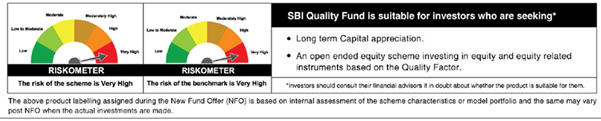 Mutual Fund investments are subject to market risks, read
all scheme related documents carefully.
Mutual Fund investments are subject to market risks, read
all scheme related documents carefully.








)
)
)
)