What Makes a Mutual Fund High Risk?
A mutual fund is generally considered high risk when its portfolio has greater potential to experience fluctuations in value due to market movements.
Several factors can contribute to this.
The most common is higher exposure to equities. Since equity prices fluctuate based on market conditions, funds with larger equity allocations generally carry higher risk than debt-oriented funds.
Another factor is the type of companies a fund invests in. Funds investing in smaller or emerging companies may experience sharper price movements than those investing in well-established businesses.
Risk can also increase when a fund follows a concentrated investment strategy. Sectoral and thematic funds, for example, focus on a specific sector or investment theme. While this allows investors to participate in particular opportunities, it also means the fund's performance is closely linked to that sector or theme specific factors that drive it
How Does the Riskometer Help?
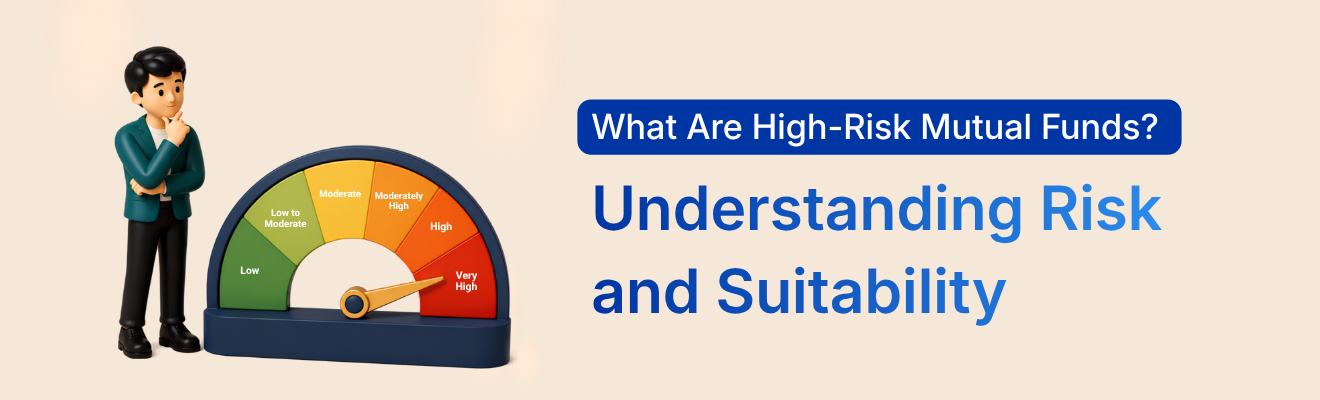
To help you understand the level of risk associated with a mutual fund scheme, SEBI has introduced the Riskometer.
Every mutual fund scheme displays a Riskometer that indicates the level of risk, ranging from Low to Very High.
The Riskometer is based on factors such as the scheme's portfolio, asset allocation and underlying investments. It is reviewed periodically and may change if the portfolio changes.
The Riskometer serves as a useful starting point when evaluating a scheme. However, it should be considered alongside the scheme's investment objective, portfolio strategy, and investment horizon before making a decision.
Which Mutual Funds Are Considered High Risk?
While the Riskometer reflects the risk level of an individual scheme, certain mutual fund categories are generally associated with higher levels of market risk because of the nature of their investments.
Let's look at some of these categories and where SBI Mutual Fund has offerings.
Small Cap Funds
Small cap funds invest predominantly in companies ranked 251st and beyond in terms of market capitalisation.
These companies often have significant growth potential, but they may also experience sharper price movements than larger companies. As a result, small cap funds can be more volatile, especially over shorter time periods.
For instance, SBI Small Cap Fund invests predominantly in a well-diversified basket of small cap equity stocks for long-term capital growth, and carries a Very High risk rating, in line with the category.
Mid Cap Funds
Mid cap funds invest predominantly in companies ranked between 101st and 250th by market capitalisation.
These companies are often in a growth phase and may offer opportunities for long-term capital appreciation. However, they can also be more volatile than large-cap companies during changing market conditions.
For instance, SBI Midcap Fund invests predominantly in a diversified basket of midcap equity stocks for long-term capital growth, and is also rated Very High risk.
Sectoral and Thematic Funds
Unlike diversified equity funds, sectoral and thematic funds focus on a specific sector, industry, or investment theme.
Because their portfolios are concentrated, the performance of these funds is closely linked to the performance of the sectors they invest in. This concentration can increase both return potential and risk.
For instance, SBI Healthcare Opportunities Fund invests at least 80% of its assets in pharmaceutical and healthcare companies, while SBI PSU Fund invests predominantly in equity stocks of public sector undertakings. Both are rated Very High risk because concentration is the whole point of the strategy.
Does Higher Risk Mean Higher Returns?
One of the most common misconceptions is that a high-risk mutual fund will automatically generate higher returns.
In reality, risk simply reflects the possibility of greater fluctuations in the value of an investment. While funds that invest in equities, small-cap companies or specific sectors may have higher long-term return potential, there is no assurance that they will outperform lower-risk funds.
Market conditions, portfolio composition and the duration of investment all influence returns. Rather than chasing returns alone, you should first understand the nature of the risk you are taking.
Are High-Risk Mutual Funds Right for You?
High-risk mutual funds are generally considered by investors who are comfortable with market-linked investments and understand that short-term fluctuations are part of the investment journey.
For instance:
- ● An investor building wealth over the long term may choose to allocate a portion of their portfolio to small-cap or mid-cap funds.
- ● An experienced investor with conviction in a particular sector may consider a sectoral or thematic fund as a satellite allocation.
- ● Investors seeking relatively stable returns or those approaching an important financial goal may prefer lower-risk fund categories instead..
Things to Consider Before Investing in High-Risk Mutual Funds
- ● Understand the scheme's investment strategy. Two funds with the same Riskometer label may invest in very different segments of the market.
- ● Review the portfolio periodically. Since high-risk funds invest in market-linked assets, their portfolio and Riskometer classification may change over time.
- ● Consider diversification. High-risk funds can complement a portfolio but should be evaluated alongside your overall asset allocation.
- ● Invest regularly if appropriate. SIPs can help investors participate in market movements gradually, although they do not eliminate market risk.
- ● Read the Scheme Information Document (SID). Always understand the investment objective, asset allocation and associated risks before investing.
The Right Fund Starts with the Right Understanding
Before investing in a high-risk mutual fund, ask yourself three simple questions:
- ● Does this investment align with my financial goals?
- ● Am I comfortable with the level of market risk involved?
- ● Can I stay invested through market ups and downs?
The answers to these questions matter more than the "High" or "Very High" label on a Riskometer. By understanding how different mutual fund categories work and evaluating them in the context of your own investment journey, you can make more informed investment decisions.
To learn more about SBI Mutual Fund schemes, visit www.sbimf.com, download the INVESTAP NXT app, visit your nearest SBI Mutual Fund branch, or consult your financial advisor.
Frequently Asked Questions
Q1. What does "Very High Risk" mean on a mutual fund's Riskometer?
A1: It indicates that the scheme has a higher potential for market fluctuations because of its underlying investments. Investors should evaluate whether it aligns with their risk appetite and financial goals.
Q2. Is SBI Small Cap Fund a high-risk mutual fund?
A2: Yes. SBI Small Cap Fund falls under the small-cap category and carries a "Very High" Riskometer classification.
Q3. Are sectoral and thematic funds riskier than diversified equity funds?
A3: They can be, as they invest in specific sectors or themes, making them more concentrated than diversified equity funds.
Mutual fund investments are subject to market risks. Please read all scheme-related documents carefully.
Q4. Can I invest in high-risk mutual funds through a SIP?
A4: Yes. Most high-risk mutual funds offer the SIP option, allowing investors to invest regularly over time.







)
)