



-(1).png?sfvrsn=c3f15487_2)
How to Build a Passive Investment Portfolio for Different Financial Goals
To build a passive investment portfolio, first identify your financial goals and understand your investment horizon and risk profile. Once these are defined, you can choose suitable passive investment options such as Index Funds and ETFs that align with your objectives. Different financial goals may call for different portfolio approaches, making periodic reviews important to ensure your investments continue to support your evolving financial plan.
***When people hear the term passive investing, they often assume it simply means investing in an Index Fund or an ETF and leaving it untouched for years.
Building a passive investment portfolio still requires planning. The investments you choose should align with your financial goals, investment horizon and overall financial plan.
After all, saving for a holiday next year is very different from investing for retirement that may be decades away.
Understanding your goals is the first step towards building a passive investment portfolio that works for you.
Why Should Financial Goals Come First?
Every investment should have a purpose. Before selecting any investment, it is important to identify what you are investing for and when you are likely to need the money. Some common financial goals include:
●Building long-term wealth
●Planning for retirement
●Saving for a child's higher education
●Creating a corpus for major life milestones
●Meeting medium-term financial goals
Each of these has a different horizon, and horizon is what determines whether equity belongs in that goal at all. It also determines something less obvious: how you should read a market fall.
A 20% drop in a portfolio meant for a goal 15 years away is a very different event from the same drop in a portfolio meant for a goal 18 months away. Without a defined goal attached to the money, every fall looks equally alarming.
Steps to Build a Passive Investment Portfolio
Step 1: Identify Your Financial Goals
List your goals and attach three things to each one: what it is for, roughly when you will need the money, and how flexible that date is.
That last point is frequently skipped, and it changes the answer. A home down payment can often be postponed by a year. A child's college admission cannot. Goals with immovable dates need a more conservative approach as the date approaches, regardless of how far away they are today.
Step 2: Understand Your Investment Horizon
Your investment horizon is the time between now and when the money is needed. Broadly, horizon maps to asset class like this:
Time to goal What typically fits Passive options available Under 1 year Equity is generally unsuitable — the money may be needed before a market cycle plays out Liquid ETFs, short-duration debt index funds 1–3 years Debt-oriented, ideally with maturity aligned to the goal Target maturity funds maturing near the goal year 3–5 years A mix, with equity sized to what a fall would not derail Broad equity index funds alongside debt index funds 5–10+ years Equity-heavy, with a full market cycle available Broad market or large cap index fundsBut the horizon does not always end on the goal date. Retirement is the clearest example: if you retire at 60 and the corpus needs to last into your eighties, the last portion of that money has a horizon of two decades, not zero. Treating retirement as a single deadline tends to push investors out of equity earlier and more completely than the goal requires.
Step 3: Assess Your Risk Profile
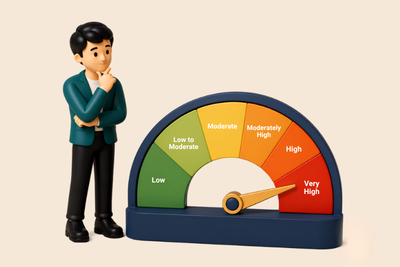
Passive funds track indices, but they carry full market risk. What they remove is fund manager risk, not market risk.
Before selecting an index type, consider your comfort with market fluctuations, your financial situation, and your ability to stay invested through a period when your chosen index is falling, because with a passive fund, there is no manager making defensive shifts on your behalf.
Step 4: Choose Suitable Passive Investment Options
Index Funds and ETFs both track indices. They differ in how you buy, price and exit them, and that difference decides which one suits you.
Index Fund ETF Demat account Not required Required SIP Built in Needs a broker SIP facility or manual purchases Transaction price That day's applicable NAV Market price, which can trade at a premium or discount to the underlying value (iNAV) Costs beyond expense ratio Exit load, where applicable Brokerage and the bid-ask spread Exiting Redeemed with the AMC Sold on the exchangeBuilding a Passive Portfolio for Different Financial Goals
Financial goals differ in more than duration. They differ in how fixed the date is, and that shapes the portfolio.
1. Long-term wealth creation
This goal usually has no fixed end date, which makes it the most tolerant of volatility of any goal on this list. Broad market or large cap indices are commonly used here, and because there is no deadline forcing a withdrawal, a fall does not have to be crystallised. The main risk here is behavioural rather than structural.
2. Retirement planning
Retirement has a date, but as noted above, the money is spent over the following two decades. A common approach is a glide path: reducing equity exposure in planned stages over the years approaching retirement, rather than in one move, while retaining some equity into retirement for the later portion of the corpus.
3. Child's future
This is the goal with the least flexible date. Admission deadlines do not move to accommodate market conditions. That argues for beginning to de-risk well before the date — often three years out — and shifting the near-term portion into debt options where maturity can be aligned to when fees are due. Target maturity funds are useful here for exactly that reason.
4. Portfolio diversification
Where passive investments sit alongside active funds, the question to answer is what each holding contributes. A Nifty 50 Index Fund held next to an actively managed large cap fund may produce substantial overlap in underlying holdings. Real diversification comes from exposure to different segments.
Common Mistakes to Avoid
When building a passive investment portfolio, investors should avoid a few common mistakes.
1. Treating index choice as a technical detail
Many investors spend time comparing two Nifty 50 Index Funds, but never ask whether Nifty 50 is the right index for the goal. The second question matters more.
2. Reading "passive" as "low risk"M/h1>
If the index falls, the fund falls with it. There is no manager stepping in to reduce exposure. Passive removes fund manager risk, not market risk.
3. Switching indices after a segment has already run
Moving from a large cap index to a small cap index because small caps did well recently is still timing the market. The fund is passive, but the decision to switch is not.
4. Holding the same exposure several times over
A Nifty 50 fund, a Sensex fund and a Nifty 100 fund together are like a single bet held three ways. It resembles diversification on paper and does not behave like it in a correction.
5. Watching constantly and rebalancing never
Rebalancing is the one active decision a passive portfolio needs. Decide the rule in advance: review once a year, or when an allocation moves beyond a set limit.
Conclusion
A passive investment portfolio is not simply about choosing an Index Fund or an ETF. It begins with understanding your financial goals, investment horizon and risk profile.
Whether you are planning for retirement, your child's future or long-term wealth creation, passive investment options can form part of a disciplined investment strategy. Reviewing your portfolio periodically and ensuring it remains aligned with your evolving financial goals can help you stay on track over the long term.
Frequently Asked Questions
Q1. What is a passive investment portfolio?
A1. A passive investment portfolio primarily consists of investments such as Index Funds and ETFs that aim to track the performance of one or more market indices.
Q2. How do I build a passive investment portfolio?
A2. Define each goal and its horizon, use the horizon to decide whether equity or debt fits, select an index whose risk profile matches your comfort level, choose between an Index Fund and an ETF based on how you invest, and set a rebalancing rule before you need it.
Q3. Can passive investing be used for retirement planning?
A3. Yes, and the horizon typically extends well beyond the retirement date, since the corpus is drawn down over the following years. Many investors use a glide path, reducing equity exposure in stages as retirement approaches rather than all at once.
Q4. How often should I review my passive investment portfolio?
A4. An annual review is a common approach, or a review triggered when an allocation drifts beyond a pre-set margin. What matters more than the frequency is deciding the rule in advance, rather than in the middle of a market move.
)