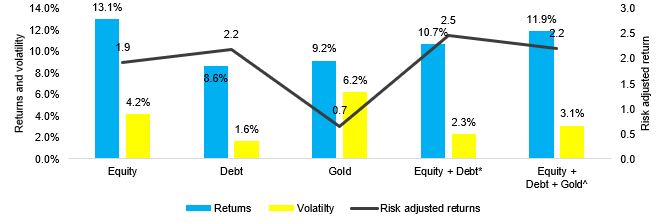
Aims to reduce volatility
Due to lack of correlation between returns of different
assets, it is difficult to predict market trends. Asset
allocation can help to offsets a better performing asset
with the impact of a downside faced by another asset.
Diversification can help distribute risks across asset
classes and try to lessen overexposure to single asset in
the portfolio. Thus, investors can get reasonable returns,
at a lower risk.
Notes:
-
Allocation between equity and debt assumed to be 50:50
-
Allocation between equity, debt and gold assumed to be
45:45:10
-
Returns – Average of 10-year CAGR on daily rolling
basis from March 31, 2008, to June 16, 2022
-
Volatility – Standard deviation of 10-year CAGR
returns from March 31, 2008, to June 16, 2022
-
Risk - adjusted returns denoted by Sharpe ratio
computed based on portfolio returns and volatility.
Risk-free rate of 5.05% used for the analysis, which
is the one-year average 91-day T-bill rate for the
period ended June 16, 2022 Debt, equity and gold
represented by CRISIL Dynamic Gilt Index, Nifty 50 and
prices of gold from goldprice.org, respectively Above
picture is for illustration purpose only and should
not be taken as base for making any investment
decision.
Risk profile
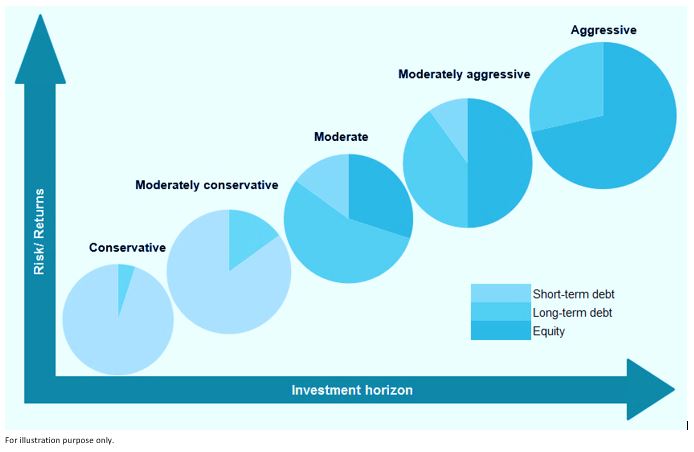
Asset allocation is based on the investor’s risk profile.
 For the aforesaid chart, kindly show different colors for
more clarity purpose
For the aforesaid chart, kindly show different colors for
more clarity purpose
Instils discipline in investment decisions
Investors are often driven by greed and fear, which forces
them to follow the herd, often leading to heavy losses.
Under such circumstances, asset allocation enforces
financial discipline and offers a balanced exposure to
various asset classes, in line with the investor’s
risk-return profile.
Asset allocation can generate better inflation-adjusted
returns
While investments in fixed income (traditional savings
instruments) assure stability, they tend to generate only
marginal inflation-adjusted returns. Equities can be an
alternative if we need reasonable returns to offset
inflation. However, instead of letting equities dominate the
kitty, which poses higher risk, it is advisable that
investors hold diversified products across asset classes.
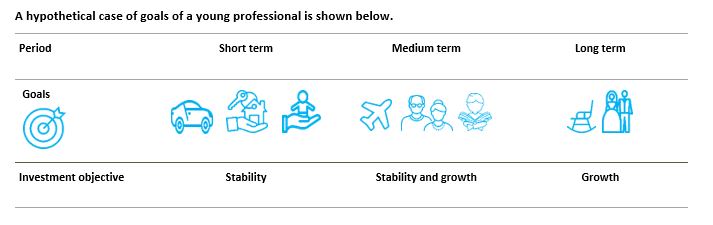
Goal-based asset allocation to achieve specific goals
A goal-based approach involves investing to achieve specific
goals (small, medium and long term) by allocating money to
different asset classes in sync with one’s risk capacity and
time horizon.
Summary
Investors may not have the wherewithal to manage their money
and allocate money across asset classes. In that case,
investors can seek professional management support to reach
their desired financial goal. Investors can also rout their
investments through mutual funds.
Disclaimer:
Mutual Fund investments are subject to market risks, read
all scheme related documents carefully.
An investor education and awareness initiative by SBI
Mutual Fund
-
Investors should deal only with registered Mutual
Funds, details of which can be verified on the SEBI
website (https://www.sebi.gov.in) under
‘Intermediaries/Market Infrastructure Institutions’.
-
Please refer to website of mutual funds for process
for completing one-time KYC (Know Your Customer)
including process for change in address, phone number,
bank details, etc.
-
Investors may lodge complaints on www.scores.gov.in
against registered intermediaries if they are
unsatisfied with their responses. SCORES facilitates
you to lodge your complaint online with SEBI and
subsequently view its status.








)
)

-197095f6910be4204af609b63a23bef97)
)