What Passive Investing Actually Does?
Passive investing involves strategies like index funds,
ETFs, and some fund of funds (FoFs). These products follow a
specific market index by holding the same securities in
similar proportions i.e., are rules‑based portfolios that
track a benchmark rather than trying to beat it. The key
idea is Performance moves in line with the benchmark index,
subject to tracking error and costs. There is no attempt to
pick “winning” stocks or time the market.
Passive is in the Spotlight—Right Now
Passive investing has “been around” in India for years, but
the adoption curve has steepened. January 2026 was a
landmark month — not only for flows, but for what those
flows signalled.
Passive Investment Assets Under Management (in ₹ cr)
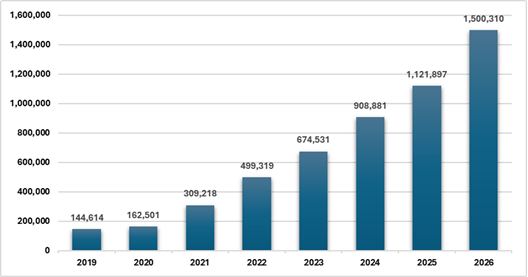 *Source: MFI Explorer, as of 30/01/2026. From 2019
to 2025, data as end of March. For 2026, data as of
30/01/2026.
Passive AUM reached ₹15 lakh crore in January 2026, with a
5-year Compounded annual growth rate over 24.61% is seen
as shown in the Graph above.
With the category clocking its highest‑ever monthly net
inflows (₹39,955 crore)—a month with gold ETFs (~₹24,040
crore) even surpassing equity fund inflows that month.
*Source: MFI Explorer, as of 30/01/2026. From 2019
to 2025, data as end of March. For 2026, data as of
30/01/2026.
Passive AUM reached ₹15 lakh crore in January 2026, with a
5-year Compounded annual growth rate over 24.61% is seen
as shown in the Graph above.
With the category clocking its highest‑ever monthly net
inflows (₹39,955 crore)—a month with gold ETFs (~₹24,040
crore) even surpassing equity fund inflows that month.
What Counts as Passive and How They Differ?
ETFs
Exchange-Traded Funds combine the convenience of mutual
funds with the flexibility of stock trading. Listed on
stock exchanges, ETFs can be bought and sold throughout
the day through a demat account, offering:
These are mutual fund designed to replicate the
performance of a specific market index, such as the Nifty
50, BSE Sensex or any other underlying index. By investing
in the same securities as the index, these funds offer:
-
Liquidity:
Trade anytime during market hours
-
Transparency:
Real-time pricing and holdings visibility.
-
Low Costs:
Minimal management fees due to passive tracking.
Index Funds
-
Simplicity:
Easy to understand and track as it mirrors market
returns.
-
Diversification:
Broad market exposure reduces individual stock risk.
-
Consistency:
Historically strong long-term returns aligned with
market growth.
Fund of Funds
A Fund of Funds (FoF) invests in a portfolio of other
mutual funds or ETFs, offering a layered diversification
strategy. These funds are curated by expert managers to
align with specific investment goals:
-
Professional Management:
Strategic fund selection and rebalancing.
-
Convenience:
One-stop solution for diversified investing with a
bouquet of multiple offerings in one fund.
Passive isn’t just broad market. India offers sectoral,
thematic, factor/smart‑beta, target‑maturity debt and
commodity passives—all with rule‑based portfolios and
SEBI‑defined guardrails, especially on debt index/ETF
construction.
Salient Features
-
Diversification based on index composition
-
Transparent and rule‑based structure
-
Lower human discretion
-
Costs that are generally lower relative to actively
managed strategies
-
Returns that move broadly in line with the market
segment being tracked
-
Applicability across equity, fixed income, and
commodities
These features describe the design of passive funds—not
their expected performance.
Why Passive Investing Is Part of Investor Conversations
Today
1. Economic Environment
Policy decisions such as the RBI maintaining the repo rate
at 5.25% (Feb 2026) form part of the economic backdrop in
which investors evaluate different categories. This
information is factual and does not signal any expected
outcome.
2. Market Volatility
Global and local markets may experience fluctuations.
Passive funds offer index‑linked exposure without the need
for frequent decision‑making at the security level. This
describes how the structure works, not whether it is
suitable for individual goals.
3. Regulatory Transparency
SEBI has issued publicly available guidelines on:
-
Tracking error
-
Tracking difference
-
Disclosure requirements.
Conclusion:
Passive investing has grown into an important part of
India’s market landscape because of its clarity,
transparency, and rules‑based structure. By following a
defined index methodology, these products allow investors to
understand exactly how the portfolio is built and what
drives its movements—without relying on constant
decision‑making or forecasting.
What makes passive strategies stand out is their consistency
of process. The index rules, rebalancing schedules, and
disclosures are publicly available, helping investors learn
how markets, diversification, and asset allocation work in a
straightforward way.
As India’s markets deepen and regulatory standards continue
to emphasise transparency, passive investing serves as a
simple and structured way for people to understand and
participate in markets. It doesn’t promise more—it simply
offers a transparent, rules‑based path that helps investors
learn how market movements translate into portfolio
outcomes, one index at a time.
Disclaimer
An Investor Education and Awareness Initiative.
Investors should deal only with registered Mutual Funds,
details of which can be verified on the SEBI website
(https://www.sebi.gov.in ) under ‘Intermediaries/Market
Infrastructure Institutions’. Please refer to website of
mutual funds for process for completing one-time KYC (Know
Your Customer) including process for change in address,
phone number, bank details etc. Investors may lodge
complaints on https://scores.sebi.gov.in against registered
intermediaries if they are unsatisfied with their responses.
SCORES facilitates you to lodge your complaint online with
SEBI and subsequently view its status.
Mutual Fund investments are subject to market risks, read
all scheme related documents carefully.







-1a9d57427fe5a46fe87c78849ae71eb41)
-197095f6910be4204af609b63a23bef97)
 Note: Cells in green to red signify the highest to
lowest inflows in that period. Source: AMFI, Crisil
Intelligence
Note: Cells in green to red signify the highest to
lowest inflows in that period. Source: AMFI, Crisil
Intelligence

)
)