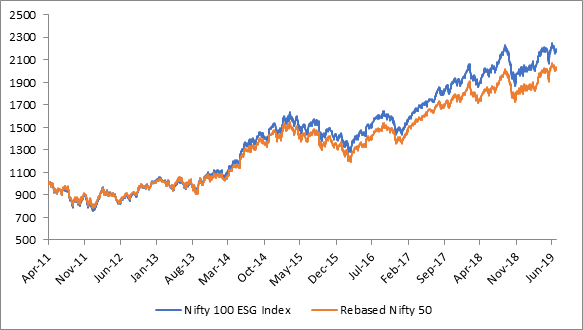
It is a fallacy to think that ethical firms sacrifice
financial performance at the cost of compliance. Empirical
evidence suggests that such companies have outperformed the
broad market indices over the long term.
 Past performance may or may not be sustained in future.
Source: NSE
Past performance may or may not be sustained in future.
Source: NSE
The Nifty 100 ESG Index is designed to reflect the
performance of companies within the Nifty 100 index, based
on ESG scores. The weight of each constituent in the index
is tilted based on ESG score assigned to the company, i.e.
the constituent weight is derived from its free float
market capitalisation and ESG score.

Nifty 100 ESG has the inception date of April 1, 2011 with
base value of 1000. Nifty 50 has been rebased to 1000 as
on April 1, 2011 for analysis. The above data is the
average of rolling returns of 3 years, 5 years and 7 years
as on June 30, 2019.
Past performance may or may not be sustained in future.
Since the ESG concept is fairly new in India and awareness
is low, very few fund houses have incorporated such funds
in their portfolio. Rising popularity and easing
scepticism about the ESG strategy will bring about
standardisation of reporting ESG-related activities
(currently mandatory for top 500 listed companies),
thereby easing the challenges of making an objective
assessment of such firms.
ESG provides investors an opportunity to not only reap
financial benefits, but also sow a seed for
socially-responsible activities. Using one’s funds to make
the world a better place, beyond selfish aspirations, is a
notion that captures the essence of sustainable investing.
Investors should, however, do due diligence on the chosen
fund and map it to their risk-return profile and
investment objectives. Investors shall always refer to the
Scheme Information Document and Key Information Memorandum
of the schemes carefully to understand the detailed risk
factors associated with the scheme. They can also seek the
help of a financial advisor.








)
)
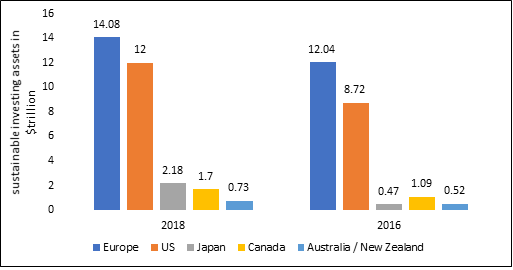 Source: Global Sustainable Investment Alliance (GSIA):
2018 Sustainable Investment Review
Source: Global Sustainable Investment Alliance (GSIA):
2018 Sustainable Investment Review

-197095f6910be4204af609b63a23bef97)
)