What are Gilt Funds?
Gilts funds are schemes offered by domestic mutual funds
wherein they invest the pooled money exclusively in
bonds/securities (gilts) issued by the Reserve Bank of India
(RBI) on behalf of the government. Hence, their level of
safety is similar to or higher than traditional debt
instruments. Gilt funds invest in government issued bonds,
Treasury bills, state development loans and inflation
indexed bonds. The minimum investment amount in gilts is Rs
10,000/- (please refer to the Schemer Information Document /
Key Information Memorandum to check the details of minimum
application amount) .
Soft interest rate boosts gilt funds
The value of the underlying debt instruments in a fund's
portfolio fluctuates on a daily basis (known as market risk)
owing to factors such as interest rate movement and
liquidity. The price of a debt instrument and interest rates
(yields) move in opposite directions, i.e. price of a bond
rises when interest rate falls and vice versa.
The net asset value (NAV) of a debt fund scheme replicates
the price of the underlying securities. Hence, if interest
rate falls, NAV rises. When interest rate eases, gilt funds
benefit more than other shorter maturity funds owing to
longer maturity of the underlying securities held by the
former.
Gilt funds
would see a higher price change as these securities mature
later and, thus, are able to hold on to higher interest
rates for a longer time in a falling interest rate scenario.
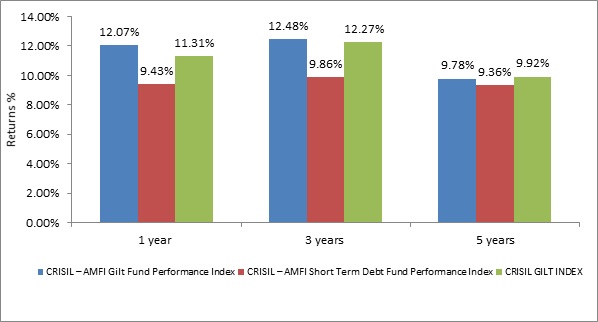
Gilt funds represented by the CRISIL – AMFI Gilt Fund
Performance Index have outperformed the benchmark CRISIL
Gilt index and short-term funds. Gilt funds returned 12.07%,
12.48% and 9.78% over 1 year, 3 years and 5 years against
9.43%, 9.86% and 9.92% by short-term funds (represented by
CRISIL – AMFI Short Term Debt Fund Performance Index)
Chart 1: Performance of Gilt funds across different time
frames
Data as on September 30, 2016, Returns above 1 year are
annualized.
Historical data shows that gilt funds have the ability to
generate higher returns than short-term debt funds in an
easing interest rate cycle. During flat rate cycle or high
interest rate periods, these funds tend to underperform
short-term and money market funds.
Past Performance may or may not be sustained in future.
Source: CRISIL Research database
Historical data shows that gilt funds have the ability to
generate higher returns than
short-term debt funds
in an easing interest rate cycle. During flat rate cycle
or high interest rate periods, these funds tend to
underperform short-term and money market funds.
Table 1: Performance of gilt funds across different interest
rate cycles
| Market Cycles |
Period |
|
CRISIL- AMFI indices Returns (%) |
|
Start Date |
End Date |
CRISIL – AMFI Gilt Fund Performance Index |
CRISIL – AMFI Income Fund Performance Index |
CRISIL – AMFI Money Market Fund Performance Index
|
CRISIL – AMFI Short Term Debt Fund Performance Index
|
| Secular decline in yields in 2000-04 |
1-Apr-00 |
30-Apr-04 |
16.43 |
12.02 |
7.19 |
NA |
| Flat to high interest rate period of 2004-08 |
30-Apr-04 |
31-Jul-08 |
3.25 |
4.20 |
6.47 |
6.42 |
| Sharp correction in yields in 2008 |
31-Jul-08 |
31-Dec-08 |
25.71 |
19.18 |
3.85 |
5.13 |
| Flat to high interest rate period of 2008-11 |
31-Dec-08 |
16-Apr-12 |
0.88 |
4.44 |
6.70 |
7.08 |
| Post RBI's repo rate cut in April 2012 |
16-Apr-12 |
20-Sep-13 |
5.95 |
7.25 |
8.92 |
8.34 |
| Post RBI's repo rate hike |
20-Sep-13 |
27-Jan-14 |
1.97 |
1.88 |
3.38 |
3.53 |
| RBI's status quo |
27-Jan-14 |
14-Jan-15 |
16.25 |
13.74 |
8.71 |
10.55 |
| RBI's surprise rate cut |
15-Jan-15 |
31-Jan-15 |
1.05 |
0.81 |
0.35 |
0.48 |
|
Repo rate cut in April 2016 and hopes of further cuts
|
31-Jan-15 |
31-Jul-16 |
8.57 |
7.71 |
8.38 |
8.70 |
Taxation
Investment in debt funds
including gilt funds for a period exceeding 36 months
qualifies for long-term capital gains tax at 20% with
indexation. Indexation helps investors to use inflation to
reduce tax liability. For instance, in the three years ended
August 2016, gilt funds gave 12.09% returns while the cost
inflation index during the period grew by 6.21%. This
results in indexed returns for the investor of 5.88% only,
sharply lower than actual returns. Investors should,
however, note that short-term capital gains tax for period
equal to or less than 36 months is subjected to tax as per
the income tax bracket.
| Particulars |
Gilt funds* |
Bank FDs** |
| Returns* |
12.09% |
9.10% |
| Cost inflation index growth |
6.21% |
- |
| Returns post indexation benefits |
5.88% |
9.10% |
| Tax rate |
23.69%^ |
35.54%^ |
| Post tax returns |
10.75% |
6.04% |
|
* represented by CRISIL – AMFI Gilt Fund Performance
Index (Data as on August 31, 2016), ** for the
maturity of 3-5 years (Source: RBI), ^ including 15%
surcharge + 3% cess
|
|
|
Suitability
Although gilt funds are credit risk-free since they invest
in government securities, they are subject to interest rate
risk. As explained, they benefit during falling interest
rate scenario and vice versa. Further, even in a falling
interest rate scenario, investment in gilt funds will be
more beneficial to those who make the first move and are
capable of taking tactical calls on interest rate movement.
These funds are thus suitable for investors with a higher
risk profile and moderate investment horizon of over three
years.
Disclaimer :
Any information contained in this article is only for
informational purpose and does not constitute advice or
offer to sell/purchase units of the schemes of SBI Mutual
Fund. Information and content herein has been provided by
CRISIL Research, a Division of CRISIL Limited, and is to be
read from an investment awareness and education perspective
only. The views / content expressed herein do not constitute
the opinions of SBI Mutual Fund or recommendation of any
course of action to be followed by the reader. Investors
should consult their financial advisers before taking any
investment decision.
Mutual Fund investments are subject to market risks, read
all scheme related document carefully.








)
)

-197095f6910be4204af609b63a23bef97)
)