The Novel Coronavirus (Covid-19) is creating havoc on global
economies. The upheaval has had a crippling effect on Indian
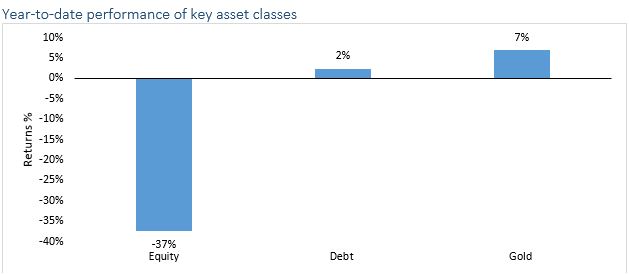
equity markets as well, with the benchmark Nifty 50 index
plunging 37% year-to-date (YTD) till March 23, 2020, almost
in-line with global peers. But, while equities have been
whiplashed, the other primary asset classes, viz, debt and
gold, have stayed afloat, returning 2.35% and 7% over the
period.
Notes:
-
Equity returns are calculated for Nifty 50 index
-
Debt returns are calculated for CRISIL Dynamic Gilt
Index
-
Gold returns are calculated from London Bullion Market
Association (LBMA) prices converted to Indian rupees
-
Data is for December 2019 to March 23, 2020
Source: CRISIL Research
So, does this mean that investors should offload equities
and move their investments to the other asset classes? Sure,
stocks have cratered YTD. But, the answer is an emphatic
‘No’. Before rushing for the exit, investors should be aware
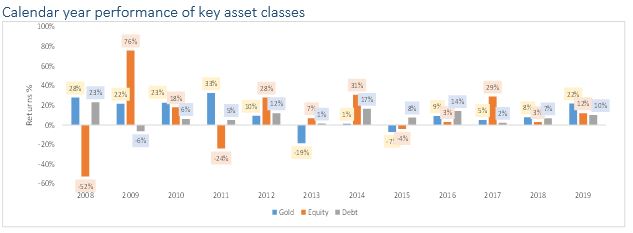
that all asset classes are subject to pulls and pushes. Even
debt, which is supposed to be a stable asset class, and
gold, which a traditional investment vehicle, are not immune
to volatility. Like for instance, in 2009, debt fell 6%
while in 2013, gold lost 19%.
Notes:
-
Calendar year point-to-point returns
-
Gold returns calculated from LBMA prices converted to
Indian rupees
-
Equity returns calculated for Nifty 50 Index
-
Debt returns calculated for CRISIL Dynamic Gilt Index
Source: CRISIL Research
Hence, bouts of short-term volatility is not a clarion call
for investors to shun equities. To be sure, equities have
the ability to rebound on positive cues, as has been evident
over several instances. Also, just as debt can lend balance
to a portfolio, equities can provide the booster to returns.
So, do not rush to redeem or stop equity systematic
investment plans or other equity investment vehicles. This
volatile spell should not make investors allocate more to
debt and gold. Because, while debt can act as a cushion
against market volatility, it may not always be able to beat
inflation. Further, gold has largely done well as a safe
haven asset only during choppy times.
Hence, to get the best return, investors would do better by
having a diversified portfolio.
Investment Diversification with equity, debt, and gold
generated higher risk-adjusted returns
Historically, whenever the sentiment for equities
strengthened, investors pulled out of safer assets, such as
debt, and moved into stocks to capture the gains. And when
equities pass through a bear phase, risk appetite takes a
hit, and demand for safer assets and commodities, such as
gold, rises.
Because of this inverse relationship between the asset
classes, investing in a diversified portfolio of equity
funds, debt funds and gold reduces the risk associated with
investing in a single asset.
CRISIL Research analysed the performance of a diversified
portfolio (equity, debt, and gold) as against standard
diversification (equity and debt) and standalone asset
classes. Our analysis shows that a combination of equity,
debt, and gold in a portfolio generated higher risk-adjusted
returns (Sharpe ratio) than other combination / standalone
classes.
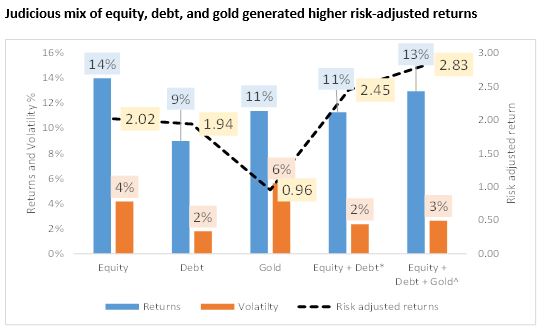 * Allocation between equity and debt assumed to be
50:50
^ Allocation between equity, debt and gold assumed to be
45:45:10
* Allocation between equity and debt assumed to be
50:50
^ Allocation between equity, debt and gold assumed to be
45:45:10
Notes:
-
Returns –
Average of 10-year CAGR on a daily rolling basis from
1997 to March 23, 2020
-
Volatility –
Standard deviation of 10-year CAGR returns from 1997
to March 23, 2020
Risk adjusted returns denoted by Sharpe ratio computed on
returns and volatility generated above Risk-free rate of
5.51% used for the analysis, which is the one-year average
91-day T-bill rate for the period ended March 18, 2020
Debt, equity and gold represented by CRISIL Dynamic Gilt
Index, Nifty 50 and LBMA gold prices, respectively
But, a word of caution. Investors should note that
allocation to different asset classes within a diversified
portfolio should be in line with the age, risk-taking
ability, goals, and investment horizon. Risk profiling
through a formal questionnaire-based process could help
investors assess themselves on the parameters. For
instance, for an investor with aggressive risk appetite
and long term goals, equity could be the way, whereas for
short term goals, debt investing could be considered.
To sum up
In these challenging times, when markets are highly
volatile, diversification is a prudent tool to lower risk.
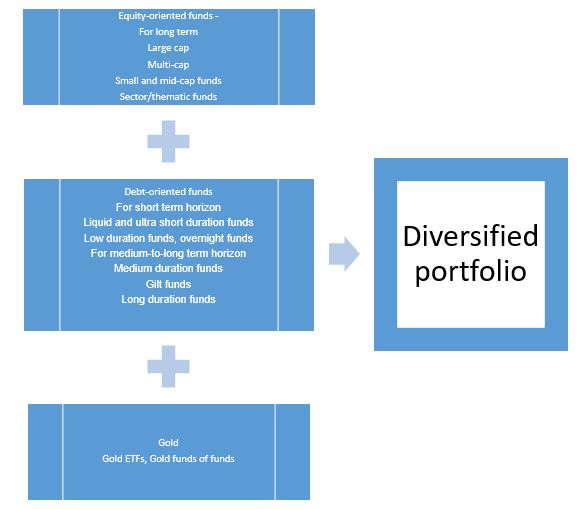
Mutual funds can help build a diversified portfolio, thereby
mitigating risks and optimising returns. That being said, do
not fall in the trap of over diversification, but stick to
allocating as per goals.
Disclaimer:
Any comparison mentioned in this material is for general
information only and not intended to be relied upon as
investment advice and is not a recommendation, offer or
solicitation to buy or sell any securities or to adopt any
investment strategy. Information and content herein have
been provided by CRISIL Research, a Division of CRISIL
Limited, and is to be read from an investment awareness and
education perspective only. Recipient are advised to seek
independent professional advice before making any
investments. The views / content expressed herein do not
constitute the opinions of SBI Mutual Fund or recommendation
of any course of action to be followed by the reader. SBI
Mutual Fund / SBI Funds Management Private Limited is not
guaranteeing or promising or forecasting any returns.
Mutual Fund investments are subject to market risks, read
all scheme related documents carefully.








)


-197095f6910be4204af609b63a23bef97)
)