Risk profiling + Riskometer = Successful financial planning
Mutual fund advertisements carry a disclosure on risks.
Mutual fund schemes were labeled as blue(low risk),
yellow(medium risk) and brown(high risk). Ever wonder why?
These are indicators that help investors take decisions in
line with their risk profile and investment objectives.
Entrenching the practice deeper, capital market regulator
Securities and Exchange Board of India has advised to use
the riskometer w.e.f. July 1, 2015, as a replacement for
colour coding. What does this change mean for investors? Why
is risk profiling important? This article answers the two
questions in detail.
The Riskometer:
Under the new system, a 180-degree scale and arrow will be
used to help investors take a decision based on their risk
appetite. The riskometer will have five categories as
opposed to just three earlier:
-
Low - principal at low risk
-
Moderately low - principal at moderately low risk
-
Moderate - principal at moderate risk
-
Moderately high - principal at moderately high risk
-
High - principal at high risk
The new format increases the gradient of risk for profiling
mutual fund schemes as the needle moves from low to high
risk. The riskometer will be displayed in the scheme
information documents, the common application form and
advertisements for the scheme.
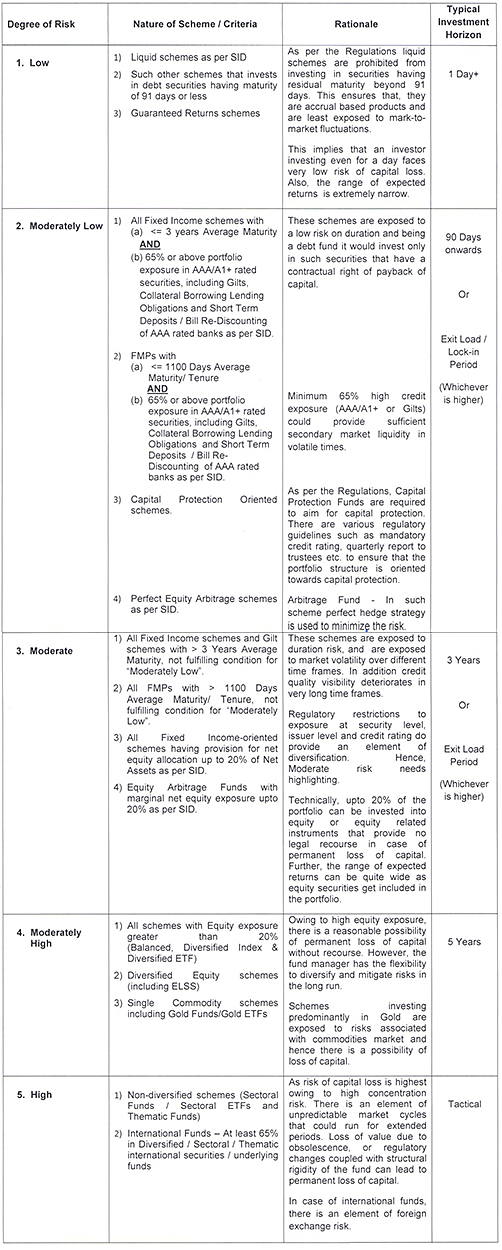
The Association of Mutual Funds of India has issued broad
guidelines to mutual funds to classify the risk profile of
funds as follows:
Understanding risk profiling:
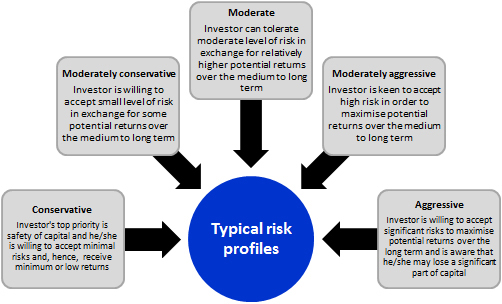
Risk profiling caters to investors assessing themselves on
various parameters to evaluate their risk-taking capacity
and, accordingly, allocate money to different asset classes.
Usually,
risk profiling
is undertaken by the financial planner through a formal
questionnaire-based process where investors have to answer
questions that probe their risk-taking capacity and
suitability. Important parameters that help gauge an
investor’s risk profile include age of the investor,
dependents, financial commitments, investment horizon,
liquidity requirements, loans/ liabilities, stability of
income, time horizon and understanding of investments and
financial markets.
Benefit of risk profiling:
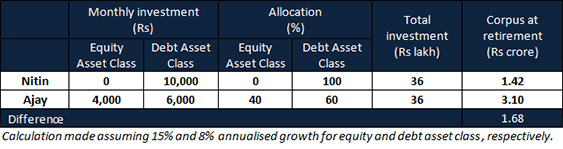
Take a look at this hypothetical example: Nitin and Ajay,
both 30, plan to retire by 60. Both have a moderate risk
profile and invest Rs 10,000 every month until they reach
that age. Nitin, despite having a reasonable risk-taking
capacity, invests only in debt asset class. Ajay, who is
clear about his risk profile, allocates his corpus between
equity
and
debt asset class in a 2:3 ratio. No prizes for guessing who
wins. Ajay ends up with a whopping Rs 1.68 crore more in his
retirement kitty compared with Nitin.
Summing up:
The
mutual fund
universe is huge and, hence, investors can use the new
riskometer to choose schemes which are in sync with their
risk appetite. The riskometer will be particularly useful to
investors who are new to the world of mutual funds. In
addition, investors are advised to consult their financial
advisor and check other criteria such as portfolio
attributes and performance parameters before investing.
Disclaimer:
Any information contained in this article is only for
informational purpose and does not constitute advice or
offer to sell/purchase units of the schemes of SBI Mutual
Fund. Information and content herein has been provided by
CRISIL Research, a Division of CRISIL Limited, and is to be
read from an investment awareness and education perspective
only. The views / content expressed herein do not constitute
the opinions of SBI Mutual Fund or recommendation of any
course of action to be followed by the reader.
Investors should consult their financial advisers before
taking any investment decision.
Mutual Fund investments are subject to market risks, read
all scheme related documents carefully.







)
)

-197095f6910be4204af609b63a23bef97)
)