Stay invested for the long term
Short-term rallies are par for the course in the equity
market. Don’t let them scare you. Stay focused and invested
for the long term as it enhances the chances of optimising
returns and reducing risks. For instance, the S&P BSE Sensex
has returned average 20% for the one-year daily rolling
return period since its inception in 1979 till August 31,
2019. However, this average includes periods of loss; the
loss probability (count of negative returns / total number
of returns) is as high as 28% in this short-holding period.
However, as the investment period expands, we see reduction
in probability of loss in a holding period of 15-20-year
rolling basis. Hence the investor shall always focus on the
long term investment in order to aim to generate returns.
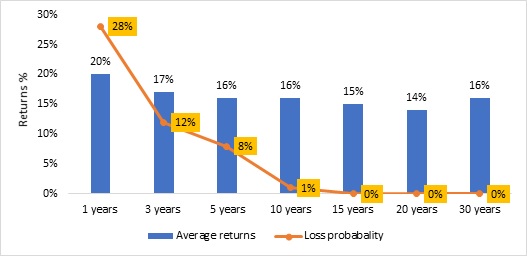 Increasing investment horizon results in return
optimisation
Source: BSE
Increasing investment horizon results in return
optimisation
Source: BSE
Notes: Past performance may or may not be sustained
in future. Daily rolling returns of S&P BSE Sensex since
inception (1979) considered across various periods. Data
for the period ended August 31, 2019.
Opt for systematic investments
Investors would be better off in the long run by investing
systematically (systematic investment plan or SIP) to derive
best benefits from the markets. In basic parlance, a SIP is
similar to a recurring bank deposit; investors contribute a
fixed sum of money at regular intervals. SIP negates the
risk of market timing, averages the cost per unit and adds
discipline to investments over the long term. Multiple
benefits have enhanced the popularity of SIP among retail
investors in recent years, as is evident from SIP inflows of
Rs 2.37 lakh crore from April 2016 to July 2019.
CRISIL Research’s analysis reveals that
SIP investments
have generally done better than lump sum returns in most
bear phases. For instance, during the sub-prime crisis
(January 2008 to March 2009), when the global markets
toppled ~45%, SIP investors’ returns were negative, so also
during the European crisis i.e. during January 2011 to June
2013 (SIP returns of 5.60% were more than lump sum returns
of -2.21%). During the bull run, there have been instances
of a sharp bounce-back after the sub-prime crisis (April
2009-December 2010) - lump sum returns were more attractive
at 51.58% than 28.76% SIP returns. However, in the post
European crisis during July 2013-February 2015, SIPs returns
(31.51%) benefitted more than lump sum returns (27.60%).
The clinching deal for SIPs came in the cumulative period
since 2008 till August 2019 when point-to-point CAGR returns
were just 5.36% versus XIRR returns of 9.76% through the
systematic route, thus showcasing the dividend of
disciplined and regular investments by investors. Investors
can optimise SIPs over the long run, helping reduce risks
from volatility in the underlying market and aim for shoring
up returns.
Investors with lump sum can invest via STP
Investors with lump sum money and wanting to invest in the
equity market, while not risking timing the market, can go
for systematic transfer plan (STP). In this, investors
invest their money in a
individual's risk profile, mostly liquid funds, and transfer money from that fund on
a periodic frequency to an equity fund of their choice. By
doing so, they may not only generate money from their
investment in the debt fund, but also aim to reduce the risk
of timing the equity market, rather investing systematically
in an equity fund. Debt funds can also be an option for the
investors to park money in the short to medium term. For
short-term goals and low risk appetite, investors can
consider investing in debt funds such as overnight, liquid,
ultra short-term, and money market funds.
Summing up
An equity investor cannot escape market volatility. Hence,
it is best to avoid the herd mentality and be rational.
Patience is the panacea. One of the best ways to overcome
influence of the crowd is to focus on an investment strategy
which is in line with individual financial goals and risk
profile.
Investors shall always refer to the Scheme Information
Document and Key Information Memorandum of the schemes
carefully to understand the investment objective and
associated risk factors of the scheme before investing.
Disclaimer:
Any comparison mentioned in this material is for general
information only and not intended to be relied upon as
investment advice and is not a recommendation, offer or
solicitation to buy or sell any securities or to adopt any
investment strategy. Information and content herein have
been provided by CRISIL Research, a Division of CRISIL
Limited, and is to be read from an investment awareness and
education perspective only. Recipient are advised to seek
independent professional advice before making any
investments. The views / content expressed herein do not
constitute the opinions of SBI Mutual Fund or recommendation
of any course of action to be followed by the reader. SBI
Mutual Fund / SBI Funds Management Private Limited is not
guaranteeing or promising or forecasting any returns.







-1)
-1)

-197095f6910be4204af609b63a23bef97)
)