A company with a stable and robust dividend record tends to
have a sustainable revenue trajectory, making it attractive
for long-term investors. That said, retail investors may
find it difficult to identify such companies. As an
alternative, they can consider investing in dividend yield
funds.
These funds invest in stocks that have a consistent history
of paying dividends and are attractively valued, besides
having sound fundamentals, healthy cash flows, and lower
return volatility across businesses and economic cycles and
various other fundamental factors.
Dividend yield measures the cash flow (by dividend) of an
investor for each rupee invested in a company. To
illustrate, let us consider company A (current market price:
Rs 50) and company B (Rs 30) have declared dividends of Rs
20 and Rs 15 per share, respectively, in one year.
Therefore, the dividend yield of company A is 40% (20/50)
and company B is 50% (15/30), making the latter more
attractive.
Dividend yield funds follow the ‘value style’ of investing,
where most stocks in the portfolio trade at attractive
valuations due to high dividends vis-à-vis stock prices.
Investors, therefore, derive income from dividends as well
as capital appreciation through an increase in stock prices.
These funds are different from mutual funds that offer
Income Distribution cum Capital Withdrawal (IDCW) options.
In a mutual fund scheme with a IDCW option, investors
receive IDCW based on distributable surplus in the fund, if
any In contrast, a dividend yield fund targets specific
stocks and investments that offer dividend pay-outs.
Diversification, lower risk and reasonable returns
Dividend yield funds allow an all-round investment and risk
assessment on a large scale, enabling investors to invest in
a diversified portfolio. Typically, investors generate
reasonable returns through an array of investments across
various companies, sectors, industries and asset classes.
Dividend yield funds have the potential to provide
reasonable returns in the long term, as their portfolio
typically includes companies with high dividend yields and a
strong track record of financial performance.
These funds are more stable than the broader market during
market volatility, as they invest in companies with stable
revenue growth and dividend distribution. They have
generated lower negative returns in bear phases, such as
during the sub-prime crisis, Chinese slowdown and Covid-19
pandemic.
Bear phase analysis
| Phases |
Dividend yield fund returns |
Nifty 50 returns |
|
Sub-prime crisis (January 2008-March 2009)
|
-40.45% |
-43.42% |
|
European crisis (January 2011-June 2013)
|
-2.54% |
-1.94% |
|
Chinese slowdown (March 2015-February 2016)
|
-17.11% |
-21.51% |
|
Covid-19 pandemic (January 2020-May 2020)
|
-29.14% |
-52.33% |
-
Notes:
Returns for less than one year are absolute, and those
over one year are annualised The dividend yield fund
category is represented by CRISIL-ranked funds, as of
December 2022
-
Source:
CRISIL Research
Dividend yield funds generally have reasonable performance
over the long term, providing reasonable returns than the
market benchmark.
Long-term performance
|
Point-to-point Returns (%) |
|
2-year |
3-year |
5-year |
10-year |
|
Dividend yield funds*
|
17.25 |
19.97 |
10.92 |
12.79 |
|
S&P BSE Sensex
|
19.19 |
13.80 |
12.48 |
11.94 |
|
Nifty 50
|
19.12 |
13.87 |
11.48 |
11.62 |
-
Note:
Eight dividend yield funds as per CRISIL
classification
-
Source:
Data as of February 21, 2023, CRISIL Research
Past performance may or may not be sustained in future
wherever returns or comparisons are shown
Assets under management growing steadily
Dividend yield funds have not yet become as popular as
equity mutual funds, but they have been steadily gaining attention. According
to the Association of Mutual Fund in India (AMFI), assets of
dividend yield funds have grown from Rs 53,004 crore in the
financial year 2019 to Rs 99,797 crore in the financial year
20231;over the past five years, at a compounded
annual growth rate of 13.49%.
Assets of dividend yield funds
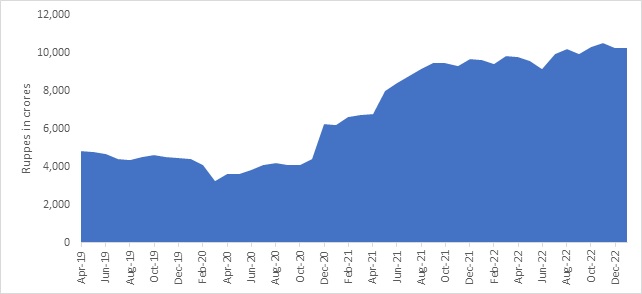 Source: AMFI data
[1] AMFI data as of January 2023
Financial markets are being roiled by multiple headwinds
back-to-back, including rising interest rates, elevated
inflation, slowing economic growth, and geopolitical issues.
In such a scenario, investors who require a long-term
investment horizon can consider dividend yield funds, which
provide a stable investment opportunity.
Mutual Fund investments are subject to market risks; read
all scheme-related documents carefully.








)
)

-197095f6910be4204af609b63a23bef97)
)