Debt funds – reasons for the rise in popularity
Debt funds, unlike traditional bank deposits, provide investors with
the opportunity to generate market-linked returns by
professional investment. While fixed deposits generally aim
to provide guaranteed returns and safety to capital, subject
to the applicable terms and conditions1 , debt mutual funds, at a slightly higher risk, provide investors with an
opportunity to invest across the debt spectrum based on
their risk-return profile and investment horizon.
Further, on the tax front, interest from bank deposits is
taxed as per the applicable tax slab of the investor, while
for debt mutual funds, investment for a period of less than
or equal to three years is subjected to short-term capital
gains tax (STCG) and hence is taxed as per applicable tax
slabs, and investment for a holding period of more than
three years, is subject to long term capital gain tax (LTCG)
and is taxed at 20% with indexation. The latter is quite
beneficial for investors with more than three years of
investment horizon, as it reduces the tax incidence
1Subject to maximum of Rs. 1 lakh by the Deposit
Insurance and Credit Guarantee Corporation (DICGC), in terms
of applicable regulations and other conditions.
A plethora of positives
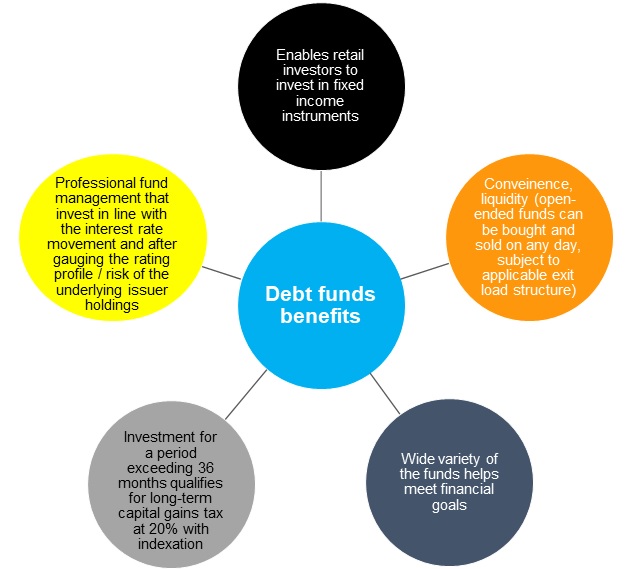
Options within debt funds to meet all short- to medium-term
goals
Additionally, debt funds offer a wide variety of choice;
there is something for every investor profile. Choice of
funds is based on personal criteria (investment horizon,
risk profile and return expectations), credit profile and
the underlying interest rate scenario.
For short-term goals and low risk appetite
Investors with a low risk appetite aiming to build an
emergency fund or having short-term goals, such as
children’s tuition fees and settlement of one-time bills,
can invest in liquid funds instead of a savings account as
the former has the potential to generate better returns at
reasonable liquidity.
Investors with a low risk-bearing capacity and short-term
horizon (from a day to a week) can choose overnight funds.
Investors with a slightly higher risk-bearing capacity can
consider investing in ultra short-term funds and low
duration funds. Note, short duration funds typically do
well in a rising interest rate scenario and they are less
sensitive to interest rate changes.
For medium- to long-term goals and ability to bear
moderate to high risk
There are short to medium duration funds with an
investment horizon of 1 to 4 years. Further for investors
with a high-risk appetite intending to invest for a medium
to long term, debt funds like gilt funds, dynamic and long
duration funds etc. with investment horizon of 4 years and
above are available.
Meanwhile, investors with the ability to take risk or the
affinity to invest in corporate bonds can look at credit
opportunity and corporate bond funds / banking and PSU funds. A credit risk fund invests minimum 65% of its
assets in corporate bonds which shall not be highest rated
instruments, while a corporate bond fund invests minimum
80% in highest rated corporate bonds.
addition, investors can consider
fixed monthly plans (FMPs)
, which resonate with bank deposits. FMPs follow a
buy-and-hold strategy which can help investors lock-in
higher yields for the entire investment period. FMPs are
close-ended debt funds with varying maturity tenures
starting from three months to five years. Investors can
only invest in or enter at the time of a new fund offer
(NFO) period. Investors wishing to exit may do so, through
the stock exchange where the FMP is listed. Redemption of
the units of the FMPs is not allowed prior to the maturity
of FMP. FMPs can generate higher tax-adjusted returns
because of the benefit of indexation (adjusting gains
after considering inflation) for a holding period of more
than three years.
Evaluate underlying risk factors before debt funds
investment
While debt funds offer a good opportunity to investors with
a low risk profile, they do come with some risks. That
notwithstanding, investors should evaluate all schemes based
on the underlying risk factors and map them onto their
risk-return profile and investment horizon.
Chart: Important risks related to debt funds
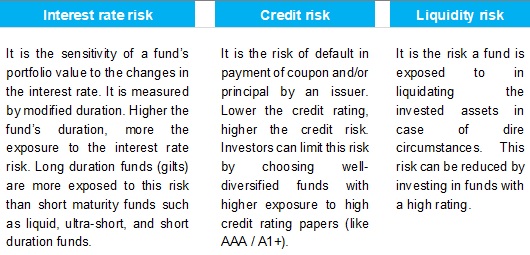 Apart from the above, certain other risks to which the
debt mutual funds are exposed to are reinvestment risk,
regulatory risk, currency risks, risk associate with
investment in derivatives, foreign instruments, etc,
depending on the investment objective and the strategy of
the fund. Investors shall always refer to the Scheme
Information Document and Key Information Memorandum
carefully to understand the detailed risk factors
associated with the particular mutual fund schemes.
Apart from the above, certain other risks to which the
debt mutual funds are exposed to are reinvestment risk,
regulatory risk, currency risks, risk associate with
investment in derivatives, foreign instruments, etc,
depending on the investment objective and the strategy of
the fund. Investors shall always refer to the Scheme
Information Document and Key Information Memorandum
carefully to understand the detailed risk factors
associated with the particular mutual fund schemes.
Disclaimer:
Any comparison mentioned in this material is for general
information only and not intended to be relied upon as
investment advice and is not a recommendation, offer or
solicitation to buy or sell any securities or to adopt any
investment strategy. Information and content herein has been
provided by CRISIL Research, a Division of CRISIL Limited,
and is to be read from an investment awareness and education
perspective only. Recipient are advised to seek independent
professional advice before making any investments. The views
/ content expressed herein do not constitute the opinions of
SBI Mutual Fund or recommendation of any course of action to
be followed by the reader. SBI Mutual Fund / SBI Funds
Management Private Limited is not guaranteeing or promising
or forecasting any returns.
In view of the individual nature of the financial or tax
consequences, each investor is advised to consult his/her
own financial/tax consultant with respect to specific tax
implications arising out of their participation in
investments. The tax rates are as per current tax laws and
are subject to change.
Mutual Fund investments are subject to market risks, read
all scheme related documents carefully.








)
)

-197095f6910be4204af609b63a23bef97)
)