Corporate bonds defined
Corporate bonds, also known as non-convertible debentures
(NCDs), are debt securities issued by companies to raise
finance. In case of
corporate bonds
the credit safety can be generally gauged by credit ratings
issued by credit rating agencies. Issuers with AAA rating
have the relatively highest safety and lower credit risk
than those with AA or below rating. Corporates compensate
investors for credit risk by offering higher yields on low
rated bonds. As seen in the second table, owing to higher
credit risk, lower rated bonds (AA+, AA, AA- and A+) provide
higher yields.
Credit ratings of different instruments
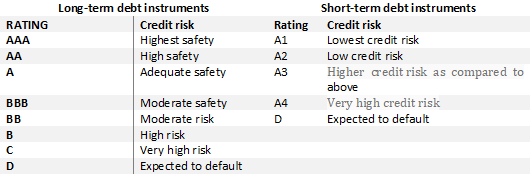 CRISIL may apply '+' (plus) or '-' (minus) signs for
ratings from 'CRISIL AA' to 'CRISIL C' in long-term debt
instruments and for ratings from 'CRISIL A1' to 'CRISIL
A4' in short-term debt instruments to reflect comparative
standing within a category.
Source: CRISIL
CRISIL may apply '+' (plus) or '-' (minus) signs for
ratings from 'CRISIL AA' to 'CRISIL C' in long-term debt
instruments and for ratings from 'CRISIL A1' to 'CRISIL
A4' in short-term debt instruments to reflect comparative
standing within a category.
Source: CRISIL
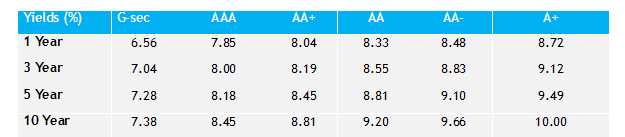 Notes: G-sec and corporate bonds data as of May 7,
2019 1 year G-Sec is represented by 6.65% CGL 2020; 3 year
G-Sec is represented by 8.13% CGL 2022; 5 year G-Sec is
represented by 7.32% CGL 2024; 10 year G-Sec is
represented by 7.26% GS 2029
Source: CRISIL Research
Notes: G-sec and corporate bonds data as of May 7,
2019 1 year G-Sec is represented by 6.65% CGL 2020; 3 year
G-Sec is represented by 8.13% CGL 2022; 5 year G-Sec is
represented by 7.32% CGL 2024; 10 year G-Sec is
represented by 7.26% GS 2029
Source: CRISIL Research
Choosing the right bond can be daunting for retail
investors as they do not have sufficient skill, knowledge
or the time to track the market. Instead, they can opt for
Corporate Bond Funds.
Corporate bond funds demystified
Corporate bond funds are open-ended mutual funds that invest
predominately in highest rated corporate bonds. As per
Securities and Exchange Board of India (SEBI), minimum 80%
of the total assets should be invested only in AA+ and above
rated corporate bonds. The fund may invest a small portion
in government securities (G-secs). The following chart shows
the credit quality analysis of CRISIL-ranked corporate bond
funds for the quarter ended March 2019 - corporate bond
funds have invested 72% of their portfolio in AAA-rated
papers, 4% each in A1+ and G-secs in March 2019.
Credit rating profile of the corporate bond funds
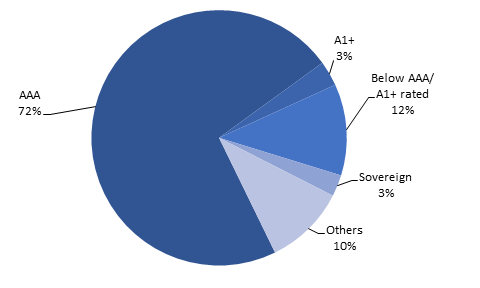
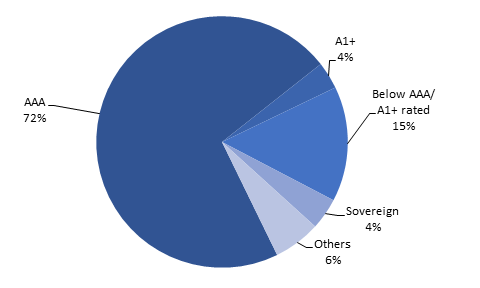 Others include cash and cash equivalents
CRISIL-ranked corporate bond funds for the quarter ended
March 2019 used for analysis Portfolio data of March 2019
Source: CRISIL Research
Others include cash and cash equivalents
CRISIL-ranked corporate bond funds for the quarter ended
March 2019 used for analysis Portfolio data of March 2019
Source: CRISIL Research
These funds typically follow the accrual strategy, wherein
the target is to generate high returns through high
accrual of interest on bonds which are mostly of shorter
duration and are held till maturity. These funds are less
exposed to volatility of the interest rate.
Accrual and duration strategy
In case of accrual funds, the fund manager aims for higher
returns by investing in shorter duration bonds with lesser
focus on capital appreciation. The search for returns is
dictated by a trade-off between yield that the fund manager
can get on corporate bonds and the credit risk he is taking
by buying higher interest-bearing (and possibly lower
credit-rated) corporate bonds.
On the other hand, duration-based funds strive for capital
appreciation by taking calls on the interest rate movement.
The fund manager increases portfolio duration for capital
appreciation when interest rate falls and decreases duration
to protect from capital losses when rate rises.
Performance
Traditional avenues generally offer steady returns, while
corporate bond funds offer an opportunity to capture
relatively higher returns, albeit at a higher risk.
Corporate bond funds represented by CRISIL Short Term
Corporate Bond Index returned 8.29%*, on average, over three
years ended April 2019 compared with 7.88%^ average returns
by the three-year FD index over the same period.
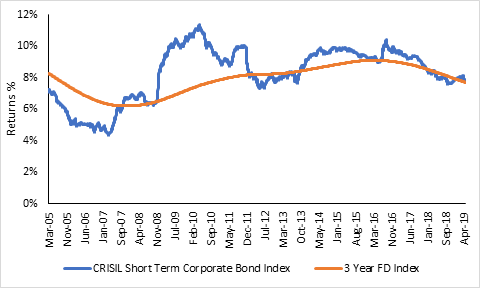 Notes: Past performance may or may not be
sustained in future.
Notes: Past performance may or may not be
sustained in future.
*Daily average rolling returns over three years
of CRISIL Short Term Corporate Bond Index since inception
(March 31, 2002) till the period ended April 30, 2019
^ Daily average rolling returns over three
years of three-year FD index since inception of the CRISIL
Short Term Corporate Bond Index (March 31, 2002) till the
period ended April 30, 2019
Three-year FD index has been calculated by considering the
simple average of FD rates of the top three (by total
deposits) public and private sector banks
Source: CRISIL Research
Fitment
Corporate bond funds can be considered as an investment
alternative for investors with a moderate risk profile and
medium-term investment horizon of 3-5 years. Like other
debt mutual funds, investment in corporate bond funds for a period exceeding
3 years qualifies for long-term capital gains tax at 20%
with indexation. However, investment in high-quality bonds
does not indicate that they are risk-free. Rating downgrade
of bonds is likely to impact fund’s returns subject to its
weightage in the portfolio. Hence, investors need to
carefully evaluate the portfolio attributes before
investing, to gauge the concentration risk, credit risks and
other risks. Investors shall always refer to the Scheme
Information Document and Key Information Memorandum of the
schemes carefully to understand the detailed risk factors
associated with the scheme. Information regarding the same
is available in the public domain or investors can seek the
help of a financial advisor also.
Disclaimer:
Any comparison mentioned in this material is for general
information only and not intended to be relied upon as
investment advice and is not a recommendation, offer or
solicitation to buy or sell any securities or to adopt any
investment strategy. Information and content herein have
been provided by CRISIL Research, a Division of CRISIL
Limited, and is to be read from an investment awareness and
education perspective only. Recipient are advised to seek
independent professional advice before making any
investments. The views / content expressed herein do not
constitute the opinions of SBI Mutual Fund or recommendation
of any course of action to be followed by the reader. SBI
Mutual Fund / SBI Funds Management Private Limited is not
guaranteeing or promising or forecasting any returns.
In view of the individual nature of the financial or tax
consequences, each investor is advised to consult his/her
own financial/tax consultant with respect to specific tax
implications arising out of their participation in
investments. The tax rates are as per current tax laws and
are subject to change.
Mutual Fund investments are subject to market risks, read
all scheme related documents carefully.







)
)

-197095f6910be4204af609b63a23bef97)
)