Navigating Uncertainty with MultiAsset Allocation
In an environment where markets rotate between risk‑on and
risk‑off, building a portfolio with more than one engine has
become less of a novelty and more of a necessity. That’s
where Multi‑Asset Allocation Funds—which combine equity,
debt, and commodities like gold and or silver (and sometimes
REITs)—fit naturally.
MultiAsset Allocation investing was once a relatively new
concept, prompting many investors to question why they
needed such a fund when they could invest small amounts
individually across equity, debt, or gold. While this was
certainly possible given the wide range of investment
options available, managing multiple assets
independently—along with feasibility, cost efficiency, tax
efficiency, and ongoing performance tracking—often proved
challenging in practice.
A Unified Portfolio Approach for Varied Market Conditions
A MultiAsset Allocation Fund, positioned within the hybrid
category, simplifies this by holding a combination of
equity, debt, and other assets such as REITs or commodities
like gold and silver within a single portfolio. Since these
asset classes do not behave in the same way at any point in
time, the performance of one is not directly linked to the
other. This natural diversification helps the portfolio
remain more balanced and potentially offers a smoother
riskadjusted experience over market cycles.
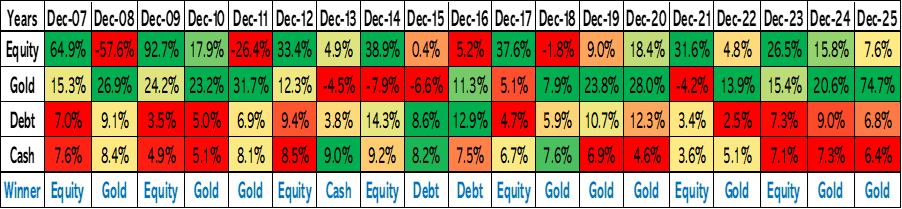
The table below highlights that different asset classes have
led performance in different years since 2007. Because their
movements are not perfectly correlated, combining them in a
portfolio allows one asset to offset another at various
times, potentially supporting a smoother overall outcome.
Table: Each asset class performance over the years
 Source: MFI Explorer; Data as on December 31, 2025
One of the biggest advantages of a MultiAsset Allocation
Fund is the blend of assets, each serving a distinct
purpose—much like a winning sports team is never made up of
only strikers or only defenders.
-
Equity
aims for growth and plays offense, taking calculated
risks when opportunities arise.
-
Debt
provides potential stability and plays defence, much
like fielders and wicketkeepers in cricket or
goalkeepers in football.
-
Commodities
like gold or silver act as allrounders, stepping up
during uncertainty and are uncorrelated to other asset
classes thus helping balance offense and defence
depending on market conditions.
Together, these asset classes form a wellrounded team
capable of handling different market “match situations,”
providing investors with a more structured and diversified
approach.
Multi Asset Approach in drawdowns:
Markets rarely move in a straight line. They shift with
cycles, policy changes, and sentiment. In such an
environment, a Multi Asset Allocation approach brings
together complementary roles—so the portfolio can adapt to
different – situations like the drawdowns.
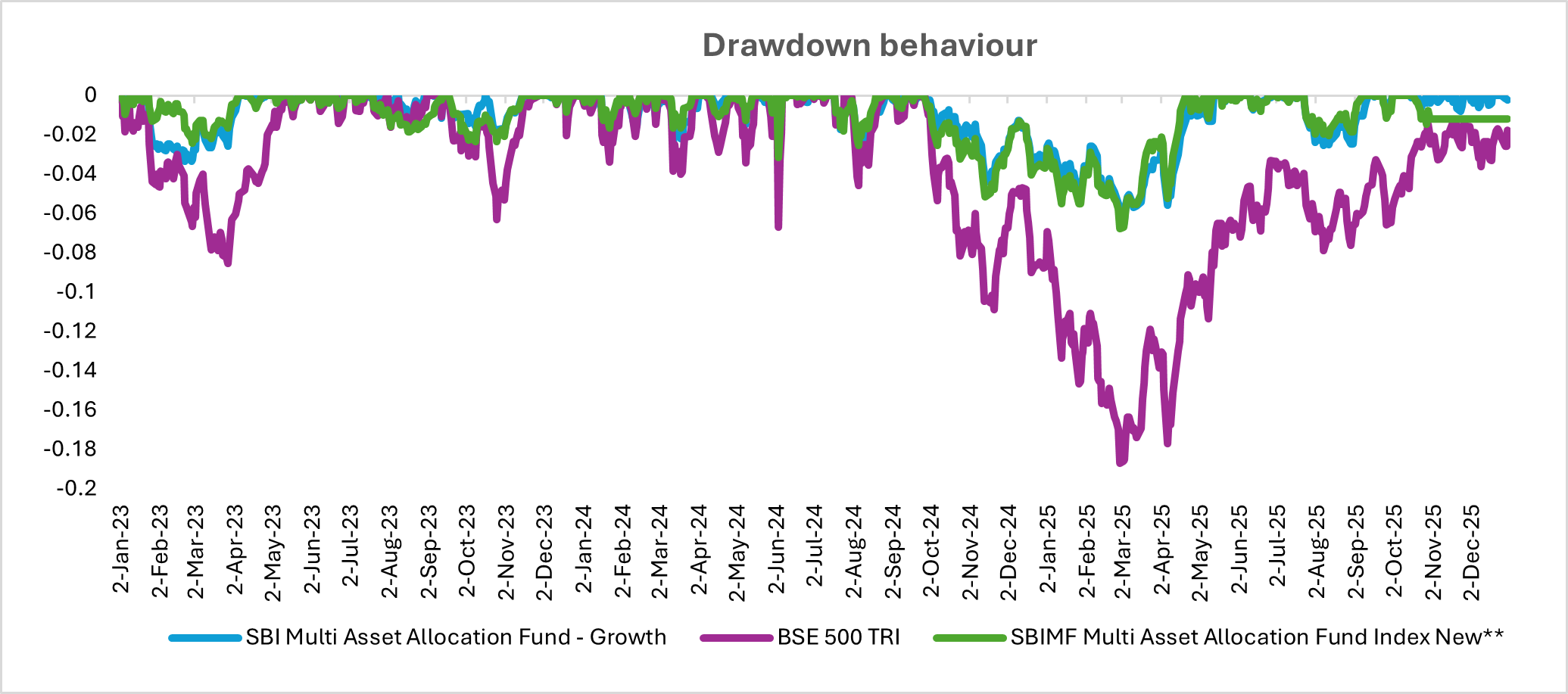
In the graph below, during market corrections, the BSE 500
TRI declined more sharply than both the SBIMF Multi Asset
Allocation Fund Index and the SBI Multi Asset Allocation Fund over the past three years—and especially in the last
year. This illustrates that, within a multi‑asset approach,
different asset classes typically don’t move in perfect
sync. Their varied behaviour helps reduce concentration risk
and bring greater balance across market phases.
Graph: 3-year drawdown movement
 Source: MFI explorer; Data as on December 31, 2025; ** A
customised index designed to serve as a benchmark for the
fund.
Source: MFI explorer; Data as on December 31, 2025; ** A
customised index designed to serve as a benchmark for the
fund.
In short, a multi‑asset approach can help during drawdowns
in several ways:
-
Diversified risk drivers:
Equity contributes to growth, debt provides
defensiveness, and gold acts as a hedge against
uncertainties.
-
Lower correlation:
When one segment of the portfolio comes under
pressure, another can help cushion the impact.
-
Rebalancing:
A disciplined “buy‑low, sell‑high” mechanism may help
smoothen the investment journey across cycles.
-
Path stability:
Even if long‑term returns are similar to other
categories, the overall experience can be more stable.
Comparative behaviour (indicative, not predictive):
-
Pure Equity:
Historically experiences deeper and faster drawdowns
during sharp market sell‑offs.
-
Aggressive Hybrid / Balanced Advantage:
Generally, displays lower drawdowns than pure equity
due to potential to shift between equity and debt.
-
Multi‑Asset Allocation:
Often comparable to aggressive hybrids in risk‑off
phases, especially when allocations to gold/silver and
debt are meaningful and are considered now as
all-weather offerings
Why does it matter now?
The current market environment makes the case for a
multiasset approach particularly compelling.
-
Global uncertainty and intermittent volatility:
Geopolitical tensions, shifting global growth trends,
and sudden riskoff phases mean market sentiment can
change quickly. Just like in a competitive match where
momentum can swing within minutes, portfolios today
may need to move from offense to defence far more
frequently than before.
-
Interestrate transitions impacting multiple asset
classes:
Changes in policy rates and expectations around future
rate cuts or hikes influence both equity valuations
and bond prices. This creates a dynamic environment
where having exposure to only one asset class may
leave portfolios vulnerable to sharp swings.
-
Domestic and global policy cues influencing market
direction:
Fiscal announcements, regulatory updates, centralbank
actions, and global macro signals can shift markets
abruptly. These policydriven movements affect
different asset classes in different ways, making a
singleasset approach more exposed.
-
Commodities like Gold & Silver’s role gaining
significance:
Whenever uncertainty rises—be it due to inflation
worries, currency dynamics, or geopolitical
tensions—commodities like gold and silver historically
played a prominent role. Its reemergence as a
diversifier adds another layer of balance within a
multiasset framework.
Conclusion — One Team, Many Roles
A MultiAsset Allocation approach is a portfolio that plays
both offense and defence. By blending equity for growth,
debt for stability, and commodities like gold and silver for
diversification, it aims to create a more measured
investment experience across market cycles. In a world where
conditions change quickly, a team with clear roles, balance,
and discipline helps investors stay the course—focused on
the full season, not just the scoreboard at halftime.










)
)